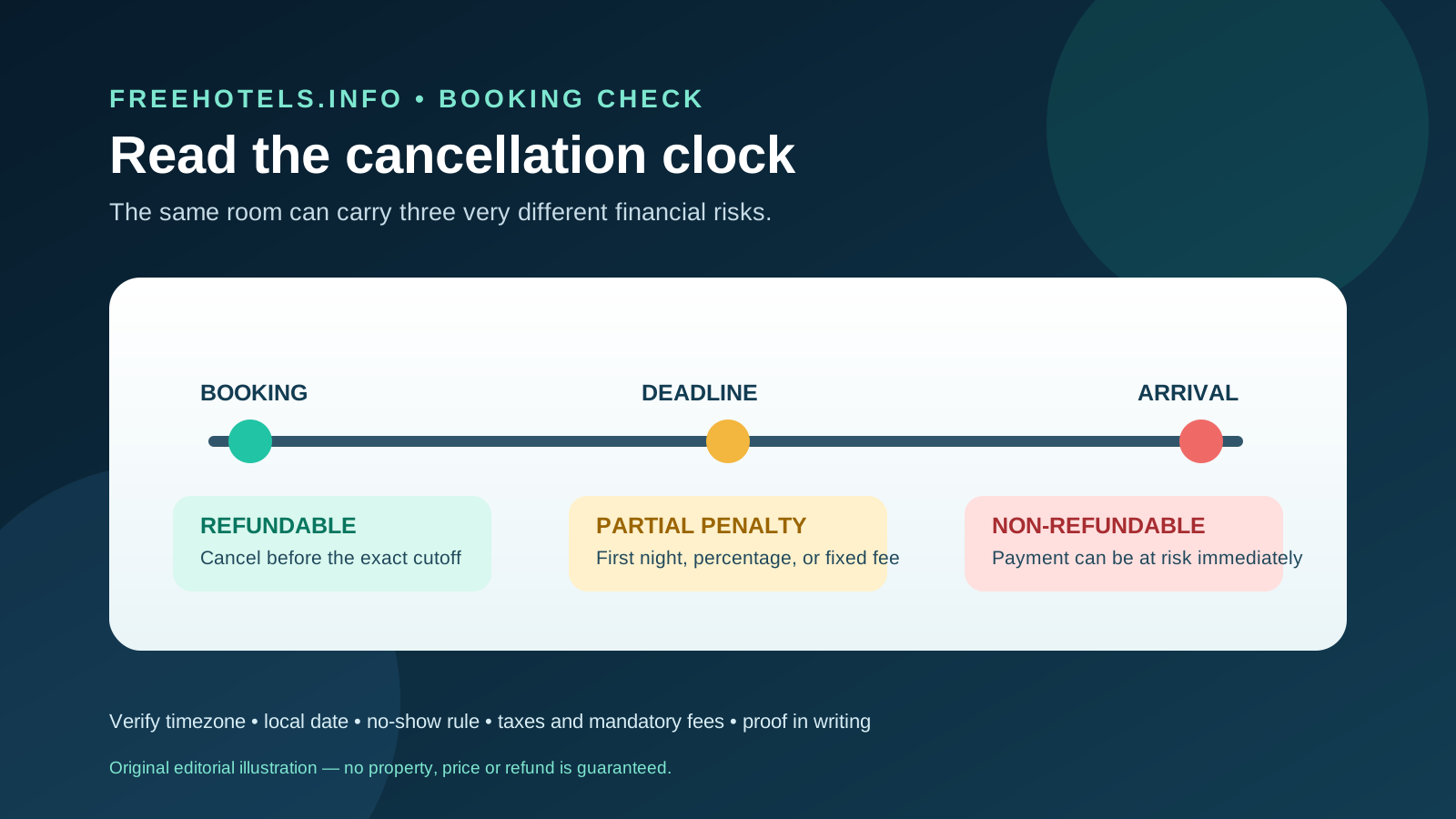
Hotel terms vary by property, rate, country, seller and booking channel. FreeHotels.info does not guarantee a refund or interpret a contract for an individual dispute.
Before booking, identify the exact cancellation deadline with its local timezone, the penalty after that deadline, whether payment is taken now, and what happens after a no-show. Save the rate rules and final price. A “free cancellation” label is useful only when it is tied to the room, dates, occupancy and booking channel you will actually purchase.
Published 16 October 2026. Evergreen consumer guide based on official FTC, European Union and European Consumer Centres Network guidance. It is general information, not individual legal advice.
Choose the flexible rate
The deadline covers the realistic period of uncertainty and the extra price is acceptable compared with the amount protected.
Choose the restrictive rate knowingly
Dates are firm, the exact amount at risk is understood, and the saving is meaningful after all mandatory charges.
Do not book yet
The seller, timezone, penalty, total price or cancellation channel remains unclear.
Start with the four facts that determine your financial risk
A hotel rate is not genuinely flexible merely because a results page displays the words “free cancellation”. The useful information is more precise: the final moment when cancellation remains free, the timezone used for that deadline, the amount charged after it, and the treatment of a no-show. Those four facts should be visible for the exact room and rate you are considering. If one is missing, do not fill the gap with an assumption based on the hotel brand or a previous reservation.
Record the deadline as a complete date and time, not as “the day before arrival”. A property may calculate the cutoff in its own local time while the traveller reads the page in another country. Daylight-saving changes, an arrival just after midnight, or a vague phrase such as “24 hours before check-in” can shift the practical deadline. Convert the stated time carefully and set a reminder earlier than the last permitted minute. A screenshot should include the room, dates, occupancy, currency and cancellation text.
Understand what free cancellation does—and does not—mean
Free cancellation normally describes the penalty for cancelling within a defined period. It does not automatically mean that no money will be taken before arrival. A hotel may place a card verification hold, take a deposit that is later refundable, or require payment while promising a refund if cancellation occurs before the cutoff. Read the payment schedule separately from the cancellation schedule. Ask how long a released hold or approved refund usually takes to appear, because bank processing time is not the same as the contractual cancellation deadline.
The label also does not guarantee that every charge connected with the trip is refundable. Currency conversion, optional insurance, a separately purchased transfer, or another supplier’s fee may follow different rules. Mandatory accommodation charges should be included in the total price where applicable, but taxes payable locally and optional services may still be presented separately. Treat the booking as a group of commitments and identify which company receives each payment.
Read the penalty formula instead of relying on a colour badge
After the free period ends, the penalty may be one night, a percentage of the whole stay, a fixed amount, or the entire reservation. These outcomes are financially different on a long booking. Calculate the maximum amount at risk using the final payable total, not the headline nightly price. If a four-night stay costs 800 in total, a one-night penalty is not necessarily 200 when nightly rates vary. The rules may define the first night at a higher weekend rate or include mandatory charges.
Look for staged penalties. A rate could be free until seven days before arrival, charge one night between seven days and 48 hours, then become fully non-refundable. Another rate may allow date changes but not a cash refund. Place each stage on a timeline and attach the amount that would be lost. This is far more informative than sorting results by a generic flexibility filter, because the filter may group together policies with substantially different deadlines.
Treat a no-show as a separate event
A no-show usually means the property believes the guest did not arrive and did not cancel under the agreed process. The penalty can differ from an ordinary late cancellation, and the hotel may release the room or cancel the remaining nights. If you will arrive late, especially after midnight, contact the property through a traceable channel and ask it to preserve the reservation. A message is not a guarantee until the hotel acknowledges it.
Transport disruption does not automatically rewrite a standalone hotel contract. Airline or rail passenger rights may provide assistance in particular circumstances, but they do not necessarily force an independently booked hotel to refund an unused room. Package travel can carry different protections from separate purchases. Keep transport and accommodation terms distinct, and do not describe one supplier’s disruption as proof of another supplier’s refund obligation.
Check whether the booking is standalone or part of a package
European consumer guidance distinguishes a standalone accommodation booking from a package that combines different travel services under qualifying conditions. A package can provide specific pre-contract information, organiser responsibility and insolvency protections. A hotel booked by itself generally depends much more heavily on the displayed rate terms and national contract law. The checkout flow should identify the trader, the service supplied and whether the purchase is presented as a package or a linked arrangement.
Do not assume that buying a flight and hotel during one online session always creates a package, or that separate confirmation numbers always mean it does not. The legal classification depends on how the services are combined and sold. For a practical booking check, save the description shown before payment, the seller’s identity and every confirmation. If rights depend on the classification, obtain advice from an appropriate consumer body rather than relying on a marketing label.
Do not assume every online hotel booking has a 14-day cooling-off period
The familiar European 14-day withdrawal right for many distance purchases has important exceptions. Your Europe lists hotel bookings for specific dates among services that do not receive the ordinary cooling-off period. That means a traveller should not purchase a restrictive rate expecting to cancel it freely two days later simply because the transaction occurred online. The rate’s own cancellation terms may apply from the moment the booking is formed.
This point matters most when a site creates urgency with a countdown or limited-room message. Pause before paying. Recheck the dates, guest names, occupancy, room type, currency and refund rule. A non-refundable discount may be sensible when plans are genuinely fixed, but the saving should be compared with the amount at risk. If the flexible rate costs 40 more and protects an 800 booking, the decision is about risk tolerance, not merely about finding the lowest displayed price.
Compare direct and intermediary bookings on identical terms
A hotel website and an online travel agency may sell the same room with different cancellation channels, payment timing, loyalty benefits or customer-service responsibility. Compare like with like: same room category, bedding, meal plan, occupancy, taxes, deadline and currency. A lower price is not equivalent if it becomes non-refundable immediately or excludes an essential service. Equally, a direct rate is not automatically more flexible merely because the hotel owns the website.
Identify who can modify or cancel the reservation. Some properties will direct an intermediary customer back to the platform, while the platform may need confirmation from the property. Save the platform policy and the property-specific rule. If a telephone promise changes a written term, request an updated confirmation before relying on it. A reservation record that still displays the old penalty leaves unnecessary ambiguity.
Verify the total price and mandatory charges before judging flexibility
The US Federal Trade Commission’s Rule on Unfair or Deceptive Fees requires covered sellers of short-term lodging to display the total price including mandatory fees more prominently than most other pricing information. The rule does not prohibit a fee or make a booking refundable. It is a price-transparency requirement. Travellers should still inspect the breakdown and distinguish mandatory charges from government taxes and genuinely optional services.
Use the final checkout total when comparing a flexible and a restrictive rate. Resort, destination, service or facility fees can change the financial difference. Also note deposits and card holds that may affect available funds even when they are not part of the eventual price. Never publish or rely on a comparison that treats an unknown fee as zero. Mark it as unknown and ask the seller to confirm it.
Build a proof pack before pressing the payment button
Keep the final offer page, cancellation rule, payment schedule, total-price breakdown and confirmation. The evidence should show the date and, where possible, the URL or booking reference. Email confirmations can omit details that appeared during checkout, so saving only the email may be insufficient. Do not include full card data in screenshots or files. Store evidence securely and redact sensitive information before sharing it with a third party.
After booking, open the reservation in the official account or management link and verify that the dates, names, room and policy match what you bought. If the confirmation differs, contact the seller promptly in writing. The FTC advises travellers to obtain cancellation and refund policies before paying, and to research unexpected travel offers independently. A proof pack cannot create rights that the contract does not provide, but it can document what was represented.
Use a controlled cancellation process
When you decide to cancel, use the method required by the booking terms and do it before the deadline. A general email to the hotel may not cancel a reservation held by an intermediary. Follow the official cancellation link or account process, then retain the cancellation number and timestamp. If the system fails, capture the error and contact the responsible seller immediately through another documented channel.
Check whether the cancellation page states the penalty before confirming. Read the result screen and subsequent email. If a refund is due, note the amount, the payment method and the expected processing period. Monitor the correct account rather than assuming silence means completion. For a card hold, ask whether it was reversed or merely allowed to expire; the bank may display those outcomes differently.
Escalate a dispute with facts, not assumptions
If the charged amount conflicts with the saved terms, contact the seller with a short chronology: booking time, rate, deadline, cancellation time, promised refund and actual charge. Attach the relevant evidence, not an unfiltered archive. Ask for a written explanation tied to the clause being applied. If the booking involved a platform, clarify whether the platform or property collected the money and which party is handling the complaint.
For cross-border European problems, the European Consumer Centres Network offers information and assistance within its remit. Other countries have their own consumer agencies and dispute routes. Card-provider procedures may have strict deadlines and evidence requirements. This guide cannot determine the outcome of an individual claim. Its purpose is preventive: make the policy concrete before purchase, keep proof, and cancel through the correct channel.
A 60-second cancellation-policy checklist
Before paying, say the answers aloud or write them in one line: free until when, in which timezone, then what penalty, payment taken when, no-show consequence, total mandatory price, and who processes cancellation. If any answer remains vague, the booking is not ready. A cheaper non-refundable rate can still be a rational choice, but it should be an explicit decision based on the amount at risk.
Finally, verify that flexibility is attached to the exact rate in the basket. Search-result badges, cached snippets and generic hotel pages are not the contract. The checkout page and confirmation for the selected dates are the decisive practical documents. Spending one minute on this check is usually more useful than comparing dozens of nearly identical listings without reading their deadlines.
- Exact deadline, local date and timezone recorded
- Penalty after each deadline calculated from the total
- No-show and late-arrival rules checked
- Prepayment, deposit and card hold separated
- Mandatory fees and taxes identified
- Cancellation channel and responsible seller known
- Rate rules and final checkout saved securely
Related verified hotel guides
- Compare the real total cost of a hotel stay
Use the same dates, occupancy, currency and mandatory charges.
- Verify hotel accessibility before booking
Confirm essential facilities directly with the property.
- FreeHotels hotel news in English
Independent analysis of hotel announcements and booking implications.
Sources
- European Consumer Centres Network — hotel booking and cancellation guidance
- Your Europe — exceptions to the 14-day cooling-off period, including date-specific hotel bookings
- US Federal Trade Commission — Rule on Unfair or Deceptive Fees FAQ
- US Federal Trade Commission Consumer Advice — obtain cancellation and refund policies before paying


