Independent general information. This guide does not guarantee admission, room availability, refunds or transport, and it does not replace the hotel’s contract or local consumer law.
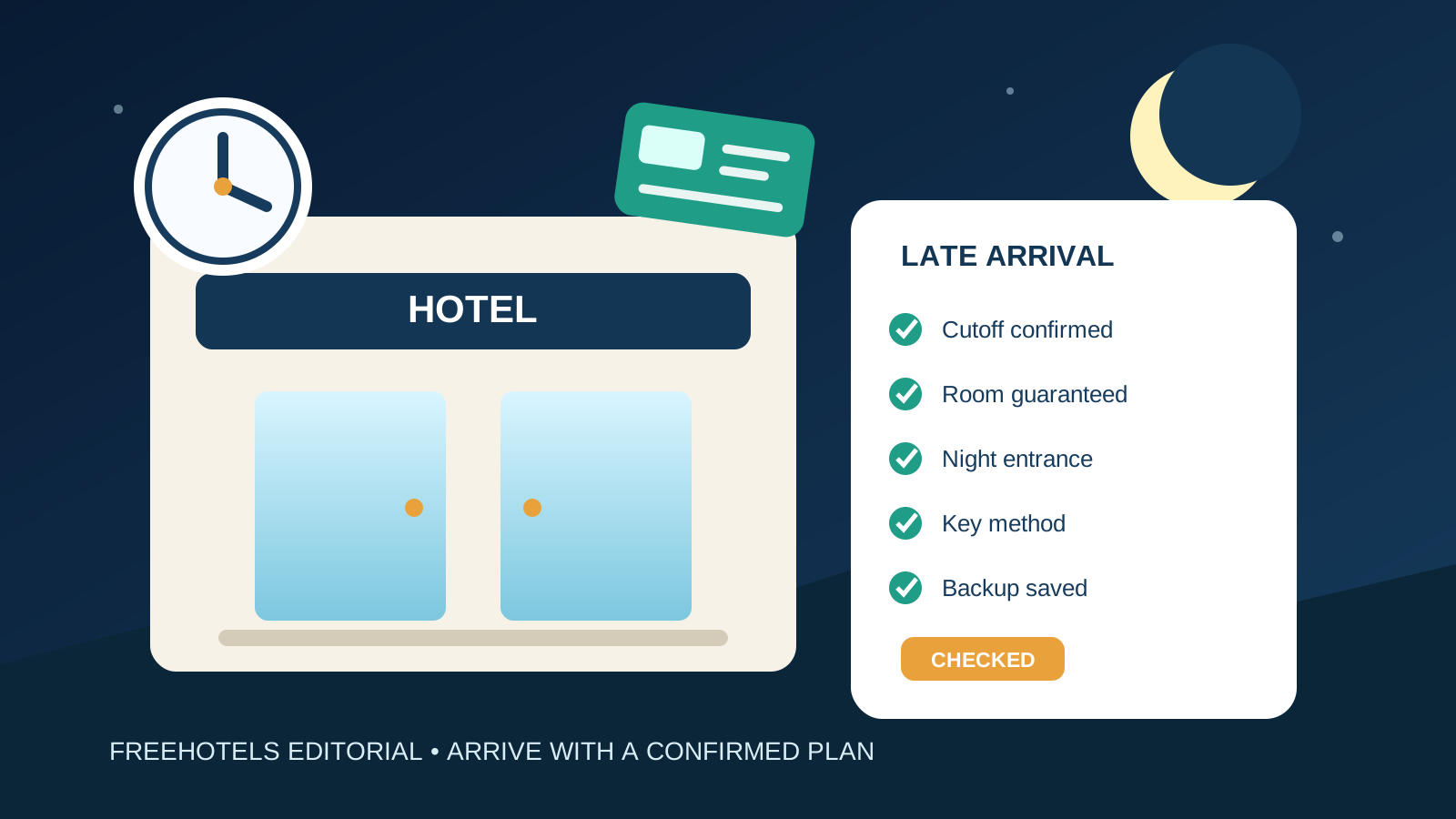
To protect a late hotel arrival, get the property to confirm in writing the latest check-in time, whether reception closes, how you will enter, when the booking becomes a no-show, which payment guarantee is required and who answers after hours. Include your booking number and realistic arrival window, then save the reply offline before the cancellation deadline.
Editorial guide published 19 October 2026. Arrival rules differ by property, rate, booking channel and country; check the terms attached to your own reservation.
The short answer: confirm six things in writing
A reservation for the correct date is not, by itself, proof that you can arrive at any hour. Before paying, identify the property’s published check-in window and ask six direct questions: What is the latest time a guest can check in? Does reception close? What exact procedure applies after closing? At what time may the reservation be treated as a no-show? Is a valid card, deposit or prepayment needed to hold the room? Which telephone number is answered during your arrival window? The reply should refer to your dates and selected rate.
Give the hotel a realistic arrival window rather than the earliest possible time. If your flight lands at 22:30, add immigration, baggage collection, transport, traffic and the walk from the drop-off point. A message that says ’late arrival’ can mean 21:00 to one employee and 02:00 to another. Writing ’expected between 00:30 and 01:30 on 20 October’ removes that ambiguity and reveals whether the booking date needs special handling after midnight.
Save the confirmation, full address, entrance instructions and after-hours contact offline. A platform chat marked ’sent’ is weaker evidence than a clear answer, and a generic automated message may not confirm anything. If the property cannot give a usable response before your free-cancellation deadline, decide deliberately whether to accept the uncertainty, choose a staffed alternative or arrange a backup. Do not convert silence into a promise.
Why ’24-hour check-in’ and ’24-hour reception’ are not the same
Booking pages use similar phrases for different services. ’24-hour reception’ usually describes staff availability, but it may still exclude check-in during a nightly audit, require the main door to be opened by intercom or apply only to guests who have already registered. ’24-hour check-in’ may mean an automated kiosk or lockbox rather than a staffed desk. ’Late check-in available’ can be conditional on advance notice, online registration, a code, an extra fee or arrival before a stated cutoff.
Read the property’s own page as well as the booking channel. Check the amenities, house rules, important-information box and rate conditions, then compare them with the confirmation email. If one screen says reception closes at 23:00 while another advertises round-the-clock access, ask which statement governs your reservation. Record the page and the date viewed. The aim is not to collect screenshots for their own sake, but to expose contradictions while you can still change the booking.
Distinguish arrival at the building from completion of check-in. A key safe may let you enter, yet the property may require identity verification, a registration form, a local tax payment or a security deposit first. Conversely, online check-in may collect details without providing a door code until the room is ready. Ask for the full sequence from street entrance to room door, including the step that releases the key or code.
Understand the no-show cutoff
A no-show is not simply ’someone who never came’. The relevant definition and timing come from the selected rate and property’s terms. Some reservations are held through the night when guaranteed by a valid payment method; others may be released after a stated hour if the guest has not contacted the hotel. A prepaid room can still be classified as a no-show for operational purposes even when money has already been collected. Never assume payment alone communicates your arrival time.
Ask the property to state the local time at which it may cancel or release the room and what happens to the remaining nights. This matters most around midnight. If you booked a room for Monday night but reach the desk at 01:00 on Tuesday, you are arriving during the night attached to Monday’s stay, not asking for an early Tuesday check-in. Put both the calendar date and time in your message so the hotel does not shift the reservation accidentally.
Also verify the financial consequence. A no-show charge might equal one night, the entire non-refundable stay or another amount defined by the terms. Taxes and extras may be treated differently. Consumer information rules can require important contract information to be supplied clearly, but they do not make every hotel booking cancellable or refundable. Your practical protection is to read the actual rate, request clarification before paying and retain the hotel’s written response.
Check how the room is guaranteed
Hotels commonly use a payment card, deposit or full prepayment to secure a booking, but those methods are not interchangeable. A card may be validated before arrival and declined if it has expired, been replaced or blocks an authorisation. A virtual or single-use card may not be accepted for an incidental deposit at the desk. Ask what must remain valid until check-in, what amount may be authorised and whether the physical card or cardholder must be present.
Do not send card numbers, security codes, passport scans or other sensitive data through ordinary email or messaging. Use the hotel’s official payment link or the booking platform’s secure workflow, and verify the domain before entering details. An unexpected message demanding a transfer or a new payment link deserves independent confirmation using the telephone number on the property’s official website, not the number inside the suspicious message.
If someone else paid, confirm what the arriving guest must present. The hotel may request an authorisation form, identification or a different card for incidentals. If a company, tour organiser or travel agent booked the room, ask which party controls changes and late-arrival notes. A note added by an intermediary is useful only if it reaches the operating property and the property confirms that it can honour the arrangement.
Map the after-hours access procedure
Request instructions specific enough to follow when tired and offline. Identify the correct entrance, not just the postal address. Large hotels may close a street door and use a side entrance at night; apartments may have separate building and unit codes; rural properties may use a key safe away from the reception building. Confirm the code delivery method, expected delivery time and what to do if it never arrives.
Check whether mobile data, an app, Bluetooth, a charged phone or a working local telephone number is required. An app-only key can fail if the device is incompatible, the account name differs from the reservation or the battery is flat. Keep a power bank where permitted, write down the after-hours number and ask whether a physical alternative exists. Do not post access codes publicly or share them beyond the travelling party.
Assess the physical route as well. Is the entrance lit? Are there stairs, gates or a long outdoor walk? Can a wheelchair user, traveller with heavy luggage or parent with a stroller complete the route? Does a car park close before the guest entrance? These are not minor details when reception is unavailable. For accessibility needs, describe the relevant requirement and obtain confirmation of the complete route from arrival point to room.
Plan around transport delays without inventing an arrival time
Build a range from evidence you control. Start with the scheduled landing or train arrival, then add the operator’s recommended exit time, baggage collection, border formalities, the actual late-night timetable and a buffer. The fastest daytime journey shown by a map is often irrelevant after midnight. Check the last train or bus, the correct stop, walking route and whether the property sits inside a restricted traffic zone.
Tell the hotel when a delay becomes known. A concise message should include the booking name, confirmation number, new estimated arrival, transport reference if useful and a request to acknowledge that the room remains held. Do not flood several channels with conflicting times. If you call, follow up with a written summary: ’Thank you for confirming by phone that arrival at approximately 01:15 is accepted and that I should use the night entrance.’
A delayed flight does not automatically rewrite the hotel contract, and travel insurance or airline duties vary by cause, itinerary and jurisdiction. Keep transport disruption records and receipts, but do not promise yourself reimbursement. If the late arrival results from a package holiday, rights may differ from those for separately purchased transport and accommodation. Contact the organiser promptly rather than assuming each supplier will coordinate.
Compare direct and third-party confirmations
When a booking platform is involved, the platform’s confirmation proves the reservation it recorded, while the hotel controls the physical arrival process. Use the platform’s official message system first so the exchange is linked to the booking, but ask for an unambiguous property response. A customer-service agent saying a request was ’sent’ or ’added’ is not the same as the hotel accepting an arrival after its normal cutoff.
Compare names, dates, occupancy, room count, rate and payment status across the platform and property records. A late-arrival note attached to the wrong room or old reservation will not help. If the hotel cannot find the booking, contact the platform before travelling and retain the case number. Avoid creating a duplicate reservation unless you understand which one can be cancelled and what each will cost.
The UK Competition and Markets Authority’s accommodation-booking work emphasises clear, accurate presentation of important information and terms. That principle supports asking for prominent arrival conditions, but it does not create a universal late-check-in rule. Properties, platforms and rates still differ. The evidence you need is the condition attached to your specific contract and the operating property’s acknowledgement.
Check identity, age and local registration requirements
Late access does not remove legal or property requirements to identify guests. Confirm which documents each traveller must present and whether registration can be completed online. Names on the booking should match the arriving guests, especially when the booker is absent. Minors, group bookings and local residents can be subject to property-specific policies. Do not assume a photocopy or digital image will replace an original document where the hotel requires one.
Some destinations collect a local accommodation tax, and some properties take a security deposit at check-in. Ask whether these can be paid after hours and which payment methods are accepted. A cashless property, a card terminal that needs a physical PIN or an online link with an expiry time can turn a confirmed room into an access problem if you only discover it at the door.
Where the property uses remote identity verification, inspect the privacy notice and official domain before uploading documents. Share only through the authorised process. If the requested information appears excessive or the link seems unrelated to the hotel, verify it independently. Security caution is compatible with timely check-in: contact the property early enough to resolve the question before reception closes.
Prepare a safe fallback
A backup is useful only if it can operate at the hour you need it. Identify one alternative with verified overnight reception or bookable same-night access, then record its address, transport route and realistic total price. Do not assume an airport hotel is always open to walk-ins or that a nearby property has rooms. During events, weather disruption or mass cancellations, local availability can disappear quickly.
Decide the trigger for using the fallback. It could be failure to receive a promised code by a certain time, inability to reach the property after two documented attempts or confirmation that the room was released. Set the trigger before travelling so fatigue does not lead you into unsafe waiting, repeated taxi journeys or unauthorised entry. If you are stranded, prioritise a safe staffed location over arguing remotely at a locked door.
Keep emergency numbers appropriate to the destination, but use emergency services only for genuine emergencies, not booking disputes. For a contractual problem, preserve the reservation, messages, call times, photos of posted hours and reasonable replacement receipts. Follow the property’s and platform’s complaint procedures. These records may support a later claim, but the outcome depends on the terms, facts and applicable law.
A message template that gets a usable answer
Send: ’Reservation [number] for [guest name], arriving for the night of [date]. Our realistic arrival is between [time] and [time] local time on [calendar date]. Please confirm: (1) the room will remain held, (2) the no-show cutoff, (3) the entrance and key procedure after [time], (4) any payment or identification step required before reception closes, and (5) the number answered then.’ This is short enough to read and specific enough to expose missing information.
If the answer addresses only one point, reply with the unanswered numbered items. Avoid asking merely whether ’late check-in is okay’; a yes without a time, procedure or reservation reference is fragile. If an extra late-arrival fee is quoted, request the amount, currency, tax treatment, payment method and refund rule in writing. Add it to the total stay cost before comparing alternatives.
Once confirmed, do not repeatedly change the arrival estimate unless the change is material. Send one update when transport disruption moves you outside the acknowledged range. Save the latest reply and keep the property informed through the authorised channel. Courtesy helps operations, but the main goal is a shared, dated record that both sides can understand.
Final checklist before you travel
Verify the property name, address, booking dates and time zone; the exact latest arrival accepted; the no-show cutoff; the payment guarantee; reception hours; night entrance; key or code delivery; identity and deposit requirements; parking or transport access; and the after-hours number. Confirm that the phone will work in the destination and that the travelling guest has the booking reference.
Download the confirmation and instructions rather than relying on a live app. Take a screenshot of the rate and cancellation terms, store the address in the map and share the safe arrival plan with a trusted member of the travelling party. Protect door codes and identity documents. If a code is supposed to arrive later, set a reminder well before the last staffed hour so there is time to escalate.
This process cannot prevent every delay, system failure or overbooking. It does reduce the common risks created by vague language: arriving after a desk closes, discovering that online registration was incomplete, losing a room at a no-show cutoff, presenting the wrong payment method or standing at the wrong entrance. A dependable late-arrival plan is one the operating property has confirmed for your reservation, backed by an offline route and a realistic alternative.
Related verified hotel guides
Sources
- Your Europe — Information you should receive before buying or signing a contract, consulted 19 October 2026
- Your Europe — Consumer rights when shopping in the EU, consulted 19 October 2026
- UK Competition and Markets Authority — Transparency for online accommodation booking sites, consulted 19 October 2026
- Hilton — Terms of service and property-specific rate conditions, consulted 19 October 2026


